
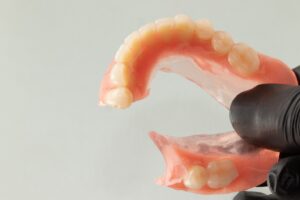
If you’ve ever felt annoyed because your lower denture slips, shifts, or lifts while you’re eating or talking, you’re not alone. Many denture-wearers find that their lower denture is less stable than their upper one. Understanding why this happens can help you and your dentist find the right solution. Let’s break down the possible culprits behind the problem, as well as what can be done about it.
Natural Anatomy Makes Lower Dentures More Challenging
Unlike an upper denture, which benefits from suction against the roof of the mouth, a lower denture rests on the lower jaw without the same natural seal. It also shares space with your tongue, cheeks, and lips, all of which move throughout the day.
These constant movements can make it more difficult for a lower denture to remain securely in place, especially while speaking or chewing.
Bone Loss Has Changed the Fit
After teeth are lost, the jawbone naturally begins to shrink because it no longer receives stimulation from tooth roots. Over time, this bone loss changes the shape of your gums and jaw, causing a denture that once fit well to become loose.
If your denture has gradually become less stable, your dentist may recommend a denture reline to improve its fit. In some cases, if the denture is older or significantly worn, replacing it may be your best option.
Your Denture May Be Worn Out
Dentures experience everyday wear-and-tear, just like natural teeth. Years of chewing can gradually wear down the artificial teeth, changing your bite and reducing stability.
In addition, the denture base itself may no longer match the contours of your gums after years of use. Most dentures eventually require adjustments, relines, or replacement to continue fitting properly and comfortably.
Dental Implants Can Improve Stability
For patients who struggle with chronic lower denture movement, implant-supported dentures can provide a dramatic improvement.
By placing a small number of dental implants in the jawbone, your dentist can attach the denture securely so it “snaps” into place. Implant-supported dentures reduce slipping during eating and speaking, improve chewing ability, and may also help slow additional jawbone loss by stimulating the bone.
Many patients find this option provides greater comfort and confidence than a traditional removable denture.
If your lower denture frequently slips, causes sore spots, or makes it difficult to eat or speak, it’s time to schedule a dental appointment. Your dentist can determine whether a simple adjustment, a reline, a replacement denture, or implant-supported dentures would best restore stability. With today’s treatment options, you don’t have to live with a loose lower denture.
About the Practice
At Columbia Healthy Smiles, we understand the challenges that people with missing teeth face. Our dentures are a wonderful solution that can restore not only your functionality but your confidence, too! Drs. Batson and Abe can provide you with a fully customized full or partial denture using state-of-the-art dental technology for precise, expert treatment. We believe in developing long-term relationships with our patients, and you’ll believe it when you receive the kind of warm, compassionate care that we’re known for. Call our Columbia office at (573) 875- 7071 or visit our website to schedule your appointment. We look forward to serving you!